Women's Health
Flo Health: Designing for the Most Personal Data a Woman Shares
Flo Health: Designing for the Most Personal Data a Woman Shares
Role: Product Designer Stage: Growth / 65M+ monthly active users Domain: Women's health, symptom tracking, consumer mobile Outcome: Symptom tracker concept contributed to a clinically validated feature published in Nature Portfolio, now used by 2.7M+ US women
Role: Product Designer Stage: Growth / 65M+ monthly active users Domain: Women's health, symptom tracking, consumer mobile Outcome: Symptom tracker concept contributed to a clinically validated feature published in Nature Portfolio, now used by 2.7M+ US women
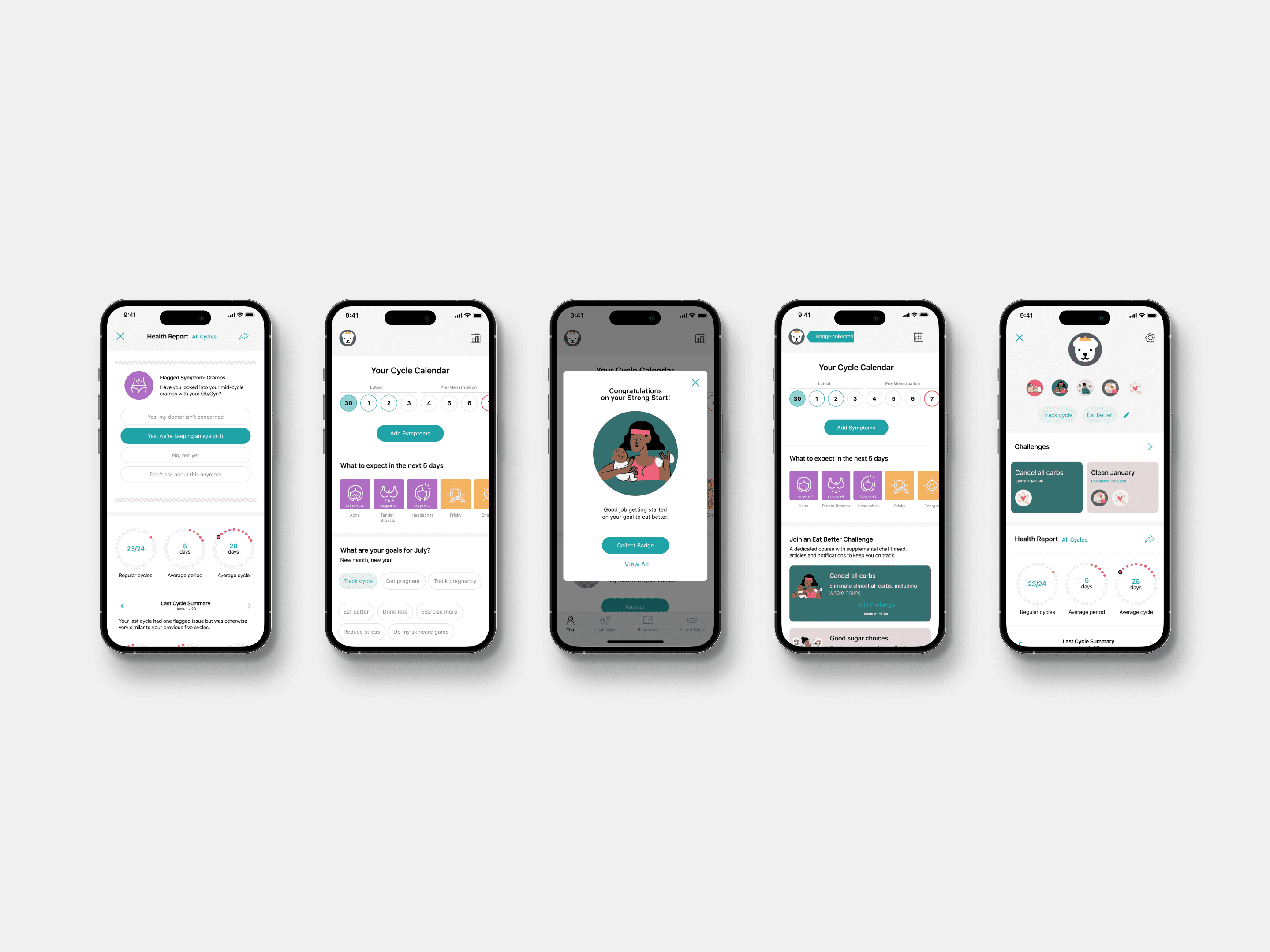

Symptom tracking at scale only works if women actually complete it daily. The existing model asked too much at the point of input and returned too little in the moment. I redesigned the concept around reducing logging friction while increasing data quality, with a feedback layer built around personal relevance rather than clinical language. The work contributed to a feature that was clinically validated, published in Nature Portfolio, and is now used by 2.7M+ US women.
Symptom tracking at scale only works if women actually complete it daily. The existing model asked too much at the point of input and returned too little in the moment. I redesigned the concept around reducing logging friction while increasing data quality, with a feedback layer built around personal relevance rather than clinical language. The work contributed to a feature that was clinically validated, published in Nature Portfolio, and is now used by 2.7M+ US women.
The Problem With Designing for Sensitive Data
The Problem With Designing for Sensitive Data
Most health apps treat personal data as a form field problem. How do we collect it efficiently, store it accurately, surface it usefully. The mechanics matter. But at a platform like Flo, with tens of millions of women logging symptoms daily, the design question runs deeper than mechanics.
Women sharing health data are making a trust decision every single time they open the app. They're not just logging a headache or a mood shift. They're creating a longitudinal record of their bodies that could eventually tell them something clinically significant. The design has to honor the weight of that without making every interaction feel heavy.
The challenge was symptom tracking specifically: how do you make daily logging accurate enough to be clinically useful without making it feel like a medical form?
Most health apps treat personal data as a form field problem. How do we collect it efficiently, store it accurately, surface it usefully. The mechanics matter. But at a platform like Flo, with tens of millions of women logging symptoms daily, the design question runs deeper than mechanics.
Women sharing health data are making a trust decision every single time they open the app. They're not just logging a headache or a mood shift. They're creating a longitudinal record of their bodies that could eventually tell them something clinically significant. The design has to honor the weight of that without making every interaction feel heavy.
The challenge was symptom tracking specifically: how do you make daily logging accurate enough to be clinically useful without making it feel like a medical form?
What I Built: Low Friction, High Signal
What I Built: Low Friction, High Signal
The dominant pattern in health tracking defaulted to comprehensiveness. Long symptom lists, multi-step logging, detailed categorization. The assumption was that more data captured meant more value returned.
The problem was completion rates. Users were starting the logging flow and abandoning it. Not because they didn't want to track. Because the interaction cost was too high relative to the perceived benefit in the moment.
The dominant pattern in health tracking defaulted to comprehensiveness. Long symptom lists, multi-step logging, detailed categorization. The assumption was that more data captured meant more value returned.
The problem was completion rates. Users were starting the logging flow and abandoning it. Not because they didn't want to track. Because the interaction cost was too high relative to the perceived benefit in the moment.
I redesigned the symptom tracking concept around a single principle: the fastest path to an honest answer is the right interaction model.
I redesigned the symptom tracking concept around a single principle: the fastest path to an honest answer is the right interaction model.
That meant reducing cognitive load at the point of input. Fewer decisions per session. Smarter defaults based on cycle stage. Visual language that felt personal rather than clinical. The goal was to make logging feel like checking in with yourself, not filling out a form.
The secondary design challenge was trust. Women needed to feel that what they shared was being used to help them, not just aggregated. Every decision in the feedback layer was made with that in mind: surfacing patterns back to the user in plain language, giving context to what the data meant, and making it clear that the product was working for them.
That meant reducing cognitive load at the point of input. Fewer decisions per session. Smarter defaults based on cycle stage. Visual language that felt personal rather than clinical. The goal was to make logging feel like checking in with yourself, not filling out a form.
The secondary design challenge was trust. Women needed to feel that what they shared was being used to help them, not just aggregated. Every decision in the feedback layer was made with that in mind: surfacing patterns back to the user in plain language, giving context to what the data meant, and making it clear that the product was working for them.
The Clinical Outcome
The Clinical Outcome
The symptom tracker concept I contributed to became the foundation for a clinically validated feature published in Nature Portfolio. That feature is now used by 2.7M+ US women.
That's not a typical design outcome. Most of the time the work produces a better conversion rate or a higher NPS. This one produced something with clinical significance for millions of women's health decisions.
It changed how I think about what design can do in a health context. The interaction decisions, what to ask, when to ask it, how to frame the question, how to return the insight, weren't just UX decisions. They were decisions that affected the quality of the data, and the quality of the data affected what the science could show.
The symptom tracker concept I contributed to became the foundation for a clinically validated feature published in Nature Portfolio. That feature is now used by 2.7M+ US women.
That's not a typical design outcome. Most of the time the work produces a better conversion rate or a higher NPS. This one produced something with clinical significance for millions of women's health decisions.
It changed how I think about what design can do in a health context. The interaction decisions, what to ask, when to ask it, how to frame the question, how to return the insight, weren't just UX decisions. They were decisions that affected the quality of the data, and the quality of the data affected what the science could show.

What This Taught Me About Designing for Health
What This Taught Me About Designing for Health
Designing for sensitive personal data requires a different calibration than most product work. The usual levers of engagement, streaks, notifications, social proof, are all available. Most of them are wrong for this context.
What works is earned relevance. The product becomes more useful as it understands you better, and it earns the right to understand you better by demonstrating that it uses what you share carefully and in your interest.
That's a slow burn compared to most engagement models. But for a product where the data is this personal and the stakes are this real, it's the only model that holds up.
Designing for sensitive personal data requires a different calibration than most product work. The usual levers of engagement, streaks, notifications, social proof, are all available. Most of them are wrong for this context.
What works is earned relevance. The product becomes more useful as it understands you better, and it earns the right to understand you better by demonstrating that it uses what you share carefully and in your interest.
That's a slow burn compared to most engagement models. But for a product where the data is this personal and the stakes are this real, it's the only model that holds up.
Result
Result
Symptom tracker concept contributed to a clinically validated feature published in Nature Portfolio. Currently used by 2.7M+ US women.
Symptom tracker concept contributed to a clinically validated feature published in Nature Portfolio. Currently used by 2.7M+ US women.
Symptom tracker concept contributed to a clinically validated feature published in Nature Portfolio. Currently used by 2.7M+ US women.




Additional Work
Additional Work
Additional Work


